
China Top 10 Test Hose Accessories Suppliers examines suppliers supporting safe, repeatable hydraulic and pressure-testing work. Test Hoses Accessories include adapters, quick couplings, protective sleeves, clamps, seals, gauges, and connection kits. Each component affects leakage control, measurement accuracy, and operator safety.
Hydraulic systems specialist Brendan Casey states, “The number one cause of hydraulic system failure is contamination.” This warning matters during hose testing. A single dirty fitting can damage a valve, distort pressure readings, or shorten hose life. Reliable suppliers should explain cleaning procedures, material choices, pressure ratings, temperature limits, and compatibility with hydraulic fluids. They should also provide traceable inspection records and clear product specifications.
This guide compares ten Chinese suppliers through practical criteria. These include manufacturing experience, quality control, customization ability, export service, response speed, and testing support. Factory photographs can help, but they do not prove performance. Samples and certificates still need review. That is the uncomfortable part.
Specifications may look complete.
Real conditions are less predictable.
Some suppliers excel at stainless-steel adapters, while others offer stronger private-label support. One may provide attractive pricing but limited documentation. Another may deliver excellent fittings with longer lead times. Buyers should compare thread standards, sealing methods, burst pressure, and replacement availability before choosing. The ranking is a useful starting point, not a final verdict. Site audits, sample testing, and direct technical discussions remain essential for dependable Test Hoses Accessories sourcing.
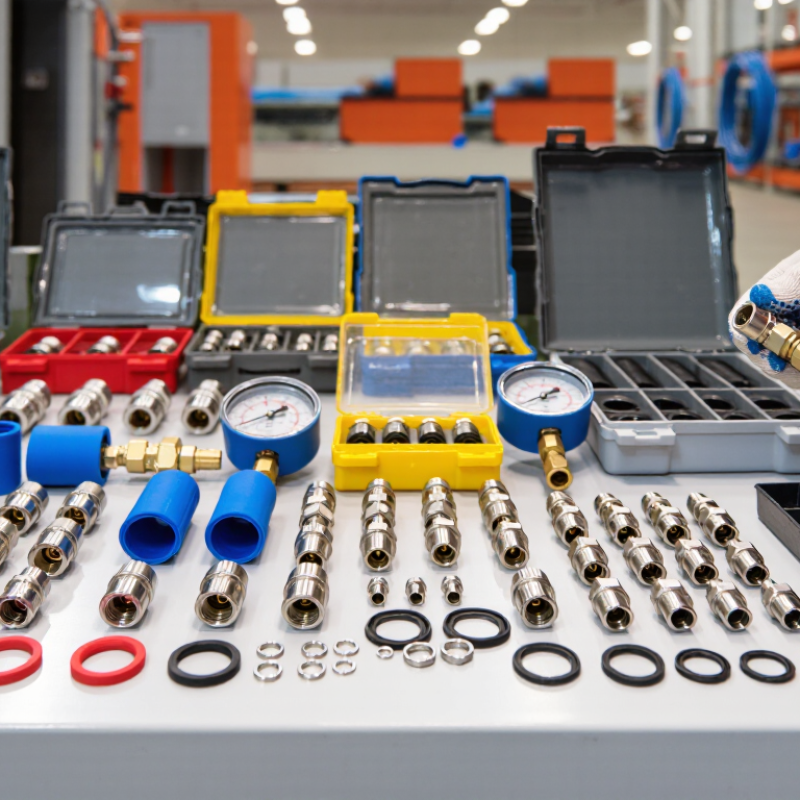
Test hose accessories support safe pressure measurement, fluid transfer, and temporary connections. Common items include adapters, quick couplings, test points, clamps, protective sleeves, and sealing washers. Each accessory must match the hose size, thread standard, medium, and pressure requirement.
Key terminology matters during supplier evaluation. Working pressure describes normal operating capacity. Test pressure indicates the level used during controlled verification. Burst pressure marks a failure limit and should never guide routine operation. Bore size affects flow, while bend radius protects the hose from sharp kinks. Thread type, sealing method, and temperature range also require careful checking.
A practical inspection starts with the fitting ends. Look for clean threads, even plating, readable markings, and undamaged seals. A loose adapter can cause leakage beside a pressure gauge, especially after repeated assembly. Protective sleeves reduce abrasion near metal edges, but they cannot repair a damaged hose. One overlooked detail is contamination inside couplings. Small particles may block narrow test channels.
Supplier documents should include material data, pressure ratings, dimensional drawings, and inspection records. Photographs help, but they are not proof of performance. A neat catalog can still hide unclear terminology. No checklist is flawless. Rechecking compatibility before shipment remains worthwhile, particularly when accessories come from different production batches.
ISO 18752 defines constant-pressure hose performance across classes from 2.5 to 56 MPa. That range changes every accessory decision. Test adapters, couplings, gauges, seals, and protective sleeves must match the hose’s pressure class. A 56 MPa assembly cannot rely on fittings rated only for general hydraulic service. During field inspections, I check thread accuracy, surface damage, and pressure records before connection.
MarketsandMarkets’ 2023 Hydraulic Hose Market report forecasts a 4.8% compound annual growth rate through 2028. That growth increases demand for traceable testing accessories. Suppliers should provide material certificates, dimensional inspection data, and calibration records. ISO 18752 also emphasizes impulse performance, dimensional control, and pressure integrity. A fitting may look correct. It can still fail under repeated impulses. This is where supplier documentation becomes practical evidence, not paperwork.
Tips: Confirm the working pressure, test pressure, thread standard, and sealing method together. Keep gauges calibrated and inspect O-rings after every high-pressure test. Use protective sleeves near operators and sharp edges. A perfect accessory list does not exist; site temperature, fluid compatibility, and human error still require review.
China Top 10 Test Hose Accessories Suppliers
China’s top ten test hose accessory suppliers were ranked through quality, production capacity, and traceability. The assessment focuses on practical evidence, not catalog claims. Quality checks included fitting dimensions, sealing performance, corrosion resistance, and pressure-test consistency. Suppliers with documented material certificates and repeatable inspection records received higher positions.
Capacity was measured through production lines, machining resources, monthly output, and realistic lead times. The highest-ranked suppliers showed stable batch control during large orders. They also maintained spare tooling and backup processes. Still, capacity figures can change during peak seasons. Buyers should request recent production data rather than rely on old presentations.
Traceability separated the strongest suppliers from the rest. Better-performing factories linked each accessory to a lot number, inspection date, operator record, and raw-material source. Some could provide test reports within one working day. Others stored information mainly on paper, which creates avoidable gaps. That weakness matters when a fitting fails in field testing. The ranking also considered sample response, technical communication, and corrective-action speed. A few suppliers delivered excellent components but had incomplete records. They were not ignored, but their positions were reduced. Practical reliability is never perfect. It must be checked order by order.
China Top 10 Test Hose Accessories Suppliers
China’s leading test hose accessory suppliers usually serve hydraulic, pneumatic, and industrial maintenance teams. Their product profiles often include couplings, adapters, test points, and diagnostic kits. Couplings should connect firmly without excessive force. Clean threads and visible seals matter during field inspections. Adapters must match thread standards, pressure ratings, and hose dimensions. A small mismatch can cause leakage or inaccurate readings.
Test points support fast pressure checks on pumps, valves, and cylinders. Reliable suppliers provide clear specifications, protective caps, and traceable material information. Diagnostic kits add practical value when technicians need hoses, gauges, adapters, and connectors together. Check case compatibility and gauge readability before ordering. Product photos are useful, but technical drawings are more dependable. I have found that packaging quality also matters, especially when small seals can disappear during transport. This detail is easy to overlook.
Tips: Request sample accessories before a large purchase. Confirm working pressure, burst pressure, temperature range, and sealing materials. Ask for inspection records and thread verification methods. Compare response times, not only prices. Suppliers should explain test procedures clearly. If a supplier avoids basic questions, pause the evaluation. Even experienced buyers can miss an incompatible sealing surface. Record every specification in writing, because memory is not a reliable quality system.
| Profile | Primary Manufacturing Region | Core Product Scope | Common Connection Standards | Typical Materials | Typical Working Pressure | Temperature Range | Quality and Documentation | Typical Application Segments |
|---|---|---|---|---|---|---|---|---|
| Supplier Profile 01 | Jiangsu | Test couplings Test points Diagnostic hoses | ISO 15171-2; metric and BSPP threaded ports; common hydraulic test-point configurations | Carbon steel with zinc-nickel or zinc plating; stainless steel available for corrosive service | Up to approximately 630 bar, depending on size, seal material, and connection design | Approximately -40°C to +100°C with standard elastomers | Dimensional inspection, pressure testing, material certificates on request, batch traceability for export orders | Mobile hydraulics, industrial hydraulic power units, agricultural machinery |
| Supplier Profile 02 | Zhejiang | Hydraulic adapters Reducers Tube fittings | ISO 1179; ISO 8434-1; DIN 2353; BSP, metric, and UNF thread formats | Free-cutting steel, stainless steel 304/316, brass for selected low-pressure applications | Approximately 250–630 bar, subject to tube size and fitting series | Approximately -40°C to +120°C, dependent on seal and plating specification | Thread gauges, leak testing, dimensional reports, RoHS and REACH declarations commonly available | Hydraulic manifolds, construction equipment, machine tools, fluid-control assemblies |
| Supplier Profile 03 | Shandong | Diagnostic kits Pressure gauges Test hoses | Metric and BSPP test points; gauge interfaces commonly using G 1/4 and G 1/2 connections | Steel test blocks, stainless steel adapters, polyurethane or thermoplastic pressure hoses | Diagnostic hose assemblies commonly rated from 250 to 630 bar | Approximately -40°C to +100°C for standard hose and seal combinations | Gauge calibration documentation, hose pressure-test records, kit packing lists, user instructions | Preventive maintenance, hydraulic troubleshooting, service workshops, industrial equipment |
| Supplier Profile 04 | Guangdong | Quick couplings Flat-face couplings Dust caps | ISO 16028 flat-face series; ISO 7241 general-purpose hydraulic coupling formats | Carbon steel with protective plating; stainless steel and thermoplastic protective caps available | Approximately 210–350 bar for common hydraulic coupling families | Approximately -25°C to +100°C with standard seals | Coupling cycle testing, burst-pressure testing, leak inspection, plating inspection, packaging verification | Industrial automation, material handling, agricultural equipment, mobile machinery |
| Supplier Profile 05 | Hebei | Test-point assemblies Minimess-style connectors Bulkhead adapters | ISO 15171-2; metric thread, BSPP thread, and SAE-compatible adapter options | Carbon steel, stainless steel 316, NBR, FKM, and polyurethane sealing elements | Approximately 315–630 bar for test-point products; lower ratings may apply to hose assemblies | Approximately -30°C to +125°C, depending on elastomer selection | Pressure-hold testing, seal inspection, thread inspection, certificate of conformity available | Hydraulic diagnostics, pressure monitoring, injection molding machines, service equipment |
| Supplier Profile 06 | Fujian | Adapters Elbow fittings Instrument connectors | ISO 8434-1; DIN 2353; BSPP, BSPT, NPT, metric, and SAE thread combinations | Carbon steel, stainless steel 316L, brass, and plated steel | Approximately 100–420 bar for common adapter and instrumentation configurations | Approximately -40°C to +200°C for selected metal-to-metal or high-temperature seal designs | Material certificates, dimensional inspection reports, pressure testing, surface-finish inspection | Process equipment, hydraulic control panels, instrumentation, energy-related machinery |
| Supplier Profile 07 | Shanghai | Service kits Test hoses Gauge adapters | Metric and BSPP test-point standards; gauge adapters for common hydraulic service interfaces | Steel and stainless steel fittings; thermoplastic or rubber-covered hose assemblies | Approximately 250–400 bar for standard diagnostic kits | Approximately -30°C to +100°C for typical hose and seal combinations | Gauge calibration options, pressure-test records, barcode or lot labeling, multilingual packing documents | OEM maintenance, service distributors, hydraulic workshops, fleet maintenance |
| Supplier Profile 08 | Hubei | High-pressure couplings Screw-to-connect couplings Adapters | ISO 14541 screw-to-connect formats; metric, BSP, and SAE adapter interfaces | Hardened carbon steel, stainless steel, nitrile seals, and fluorocarbon seals for selected media | Approximately 350–700 bar, depending on coupling size and connection type | Approximately -25°C to +120°C with suitable seal selection | Hydrostatic proof testing, burst testing by product series, hardness checks, dimensional inspection | Heavy equipment, high-pressure hydraulics, lifting systems, industrial maintenance |
| Supplier Profile 09 | Anhui | Manifold test blocks Isolation valves Diagnostic accessories | Metric and BSPP ports; ISO 1179 and ISO 8434-1 compatible connections for selected assemblies | Carbon steel, stainless steel 316, aluminum for lightweight low-pressure blocks | Approximately 250–400 bar for common test-block assemblies | Approximately -20°C to +120°C, subject to valve and seal configuration | Functional testing, leakage testing, port inspection, assembly drawings, spare-seal lists | Hydraulic power units, presses, machine tools, test benches |
| Supplier Profile 10 | Chongqing | Custom test assemblies Diagnostic kits Replacement accessories | ISO 15171-2, ISO 16028, metric, BSPP, BSPT, NPT, and SAE connection options | Plated carbon steel, stainless steel, thermoplastic hose, rubber hose, and protective polymers | Approximately 160–630 bar, based on hose, coupling, and adapter selection | Approximately -40°C to +100°C for standard assemblies; higher-temperature options may be specified | Assembly drawings, inspection reports, pressure-test records, customized labels, export packaging | Hydraulic OEMs, aftermarket service, mining equipment, transportation and utility machinery |
When screening China’s top ten test hose accessories suppliers, start with SAE J517 compatibility. SAE J517 defines hose construction, dimensions, and performance requirements. It does not guarantee perfect coupling fit. Ask for written compatibility tables, material grades, temperature limits, and fluid recommendations. Check both working pressure and minimum bend radius. A fitting can pass pressure tests yet fail during repeated movement.
Testing evidence matters more than polished catalogs. Request impulse, burst, leakage, vacuum, and temperature-cycle records for the exact assembly. ISO 6803 impulse testing can reveal early failures that static pressure tests miss. The 2024 Grand View Research hydraulic hose market report projects continued market growth through 2030, increasing pressure for reliable, repeatable testing. Still, some suppliers present only burst-pressure figures. That is not enough.
Export support should include batch traceability, inspection photos, packing specifications, and clear commercial documents. Confirm whether reports show calibrated equipment and test dates. MarketsandMarkets’ hydraulic hose market analysis also highlights industrial demand and replacement activity, where downtime costs can exceed the purchase price. I would request a pilot batch before placing a large order. It may feel slower. It can expose thread errors, seal damage, or inconsistent crimp dimensions. Ask about export experience, but verify it with sample documents, not promises.
They support pressure measurement, fluid transfer, and temporary connections.
Match the hose size, thread type, sealing method, fluid, temperature, and pressure requirement.
Working pressure describes normal operating capacity.
Bore size affects fluid flow and possible pressure loss.
Check for clean threads, even plating, readable markings, and undamaged seals.
No. Protective sleeves reduce abrasion near metal edges and operators.
Request material data, pressure ratings, dimensional drawings, and inspection records.
Static pressure results may not reveal failures caused by repeated impulses.
A pilot batch can reveal thread errors, seal damage, and inconsistent crimp dimensions.
This guide to China’s top 10 test hose accessories suppliers explains how Test Hoses Accessories support pressure measurement, fluid control, maintenance, and hydraulic system diagnostics. It introduces common products such as couplings, adapters, test points, protective caps, diagnostic kits, and connection components, while clarifying key terminology used in technical purchasing. The guide also outlines the ISO 18752 pressure-class range of 2.5–56 MPa, helping buyers compare pressure capability, durability, and application suitability.
The supplier ranking focuses on product quality, manufacturing capacity, quality-control systems, documentation, and traceability rather than brand popularity alone. Each profile considers the supplier’s ability to provide compatible couplings and adapters, reliable test points, complete diagnostic kits, and customized configurations. A practical purchasing checklist covers SAE J517 compatibility, pressure and leakage testing, material verification, batch records, packaging, technical support, and export experience. Together, these criteria help international buyers select dependable accessories for safe, efficient, and maintainable hydraulic testing systems.

TM Hydraulic