Choosing the right China Best Test Pressure Hose Manufacturer Supplier requires more than comparing prices. A reliable partner must understand pressure testing, fluid compatibility, connection types, and working environments. A Test Pressure Hose should perform steadily beside hydraulic pumps, calibration equipment, and industrial test benches. It must handle pressure changes without excessive expansion, leakage, or sudden failure.
Experienced manufacturers usually begin with the application details. They review working pressure, test pressure, temperature range, hose length, bend radius, and fitting requirements. They may also recommend protective covers for sharp edges or busy workshop areas. Small details matter. A poorly matched thread can stop an entire test operation. A clear identification mark can prevent installation errors.
Quality control should cover raw materials, assembly, cleaning, and pressure testing. Important records may include batch numbers, inspection results, and product traceability documents. A dependable supplier communicates these details clearly. They should also explain production limits instead of making unrealistic promises. No hose is perfect for every condition. Even a strong design can fail when operators ignore minimum bend radius or chemical compatibility.
Our focus is practical selection and responsible supply. We examine how Chinese manufacturers support customization, consistent production, packaging, and after-sales communication. Factory experience matters, but it should be supported by measurable procedures. Samples, technical drawings, and test reports can reduce uncertainty before bulk purchasing. The best supplier is not simply the cheapest option. It is the partner that helps users choose a safe, suitable, and maintainable hose for real pressure testing work.
What Is a Test Pressure Hose and How Is It Used?
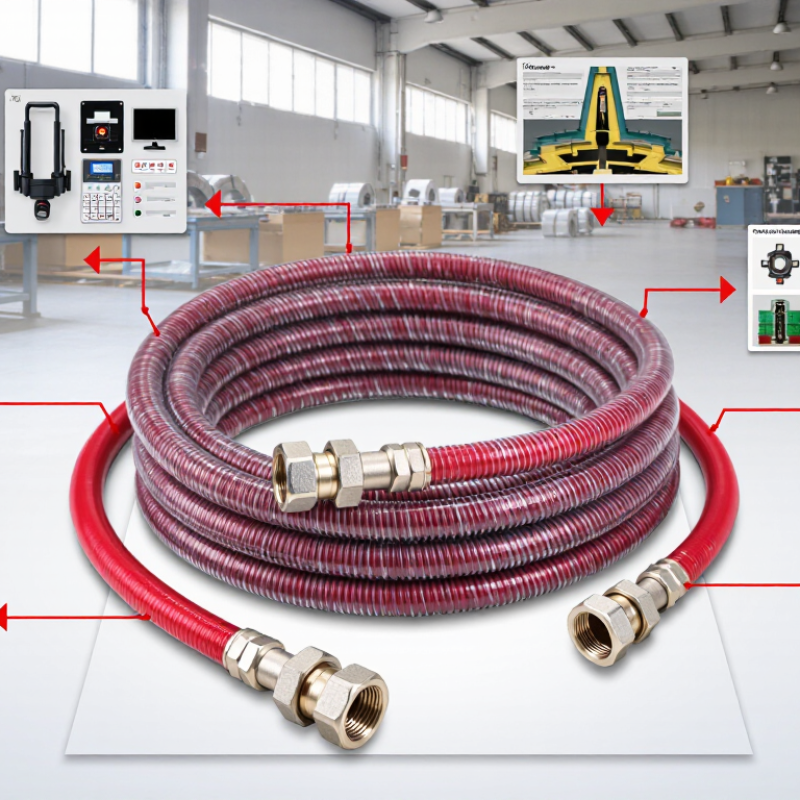
A test pressure hose is a flexible line used to transfer pressurized water, oil, or hydraulic fluid during inspection. It connects a test pump, pressure gauge, valve, or equipment port. Technicians use it to check pipelines, cylinders, pressure vessels, and hydraulic circuits before service. The hose must tolerate the planned test pressure, temperature, fluid, and pressure surges.
Pressure ratings need careful reading. ISO 18752:2014 covers hydraulic rubber hoses with working pressures reaching 56 MPa, depending on the selected class. SAE J517 also defines hose performance, dimensions, and impulse requirements for hydraulic applications. These standards support safer selection, but they do not replace site-specific risk assessment. A hose rated for 40 MPa should not automatically handle every 40 MPa test.
Use a hose with compatible end fittings and secure connections. Inspect the cover for cuts, swelling, abrasion, or exposed reinforcement. Keep the line away from sharp edges and never stand beside it during pressurization. The operator should raise pressure gradually and monitor the gauge from a safe position. A damaged hose may look acceptable at rest. That is the uncomfortable part. Many failures begin with small, ignored defects. Manufacturers and suppliers should provide traceable test data, pressure ratings, and clear replacement guidance for each assembly.
Selecting the right test pressure hose starts with its materials. The inner tube must resist the test medium, temperature, and chemical exposure. Nitrile rubber suits many petroleum-based fluids. EPDM performs better with water and some glycol mixtures. PTFE offers strong chemical resistance, but it needs careful handling because sharp bends can damage reinforcement.
Reinforcement controls pressure stability. Textile layers support lighter applications, while braided or spiral steel wire handles higher loads. Aramid reinforcement can reduce weight, although it may require stricter bend-radius control. ISO 18752 identifies constant-pressure classes from 40 to 420 bar and requires defined impulse, leakage, and burst performance. A hose rated at 250 bar working pressure is not automatically safe at 250 bar in every installation. Temperature and movement still matter.
SAE J517 provides widely used hydraulic hose dimensions and performance requirements. EN 853 and EN 856 also define construction and pressure expectations for reinforced rubber hoses. In field inspections, worn covers, exposed wire, and flattened sections remain common failure clues. Small details matter. A clean test record should include hose size, media, temperature, working pressure, and test duration. The ratio between working and burst pressure must follow the selected standard, not personal judgment. A specification can still be wrong when the laboratory conditions differ from the jobsite. Testing near the minimum bend radius is another practical weakness worth reviewing.
The chart compares representative maximum continuous service temperatures for commonly used test-pressure hose materials. Actual limits depend on hose construction, fluid compatibility, reinforcement, pressure rating, and test duration.
Pressure-test hoses are commonly evaluated using hydrostatic test procedures such as ISO 1402. Selection should also verify working pressure, burst pressure, leakage resistance, bend radius, and applicable hydraulic-hose requirements such as ISO 18752 or EN 853.
China Best Test Pressure Hose Manufacturer Supplier
How China Manufacturers Produce and Test Pressure Hoses
China pressure hose manufacturers usually begin with incoming material checks. Technicians verify rubber hardness, reinforcement wire strength, and inner-tube thickness. Mixing rooms record temperature, batch numbers, and compound ratios. This traceability matters because one small variation can weaken an entire production run.
The hose is then extruded, reinforced with textile or steel wire, and covered with an outer layer. Operators inspect braid angle and wall thickness during production. Steam vulcanization bonds the layers under controlled heat and pressure. A 2024 MarketsandMarkets analysis places the global hydraulic hose market above USD 2 billion, increasing pressure on suppliers to prove consistency. ISO 18752:2023 supports classification by pressure, temperature, and application performance.
Testing normally includes dimensional inspection, hydrostatic pressure, leakage checks, and burst testing. Some factories also conduct impulse testing under ISO 6803. The machine cycles the assembly repeatedly, exposing weak crimps and poor bonding. Real failures are useful.
A hose may pass visual inspection and still fail under repeated pressure.
Manufacturers therefore sample different production batches instead of trusting one successful test. Test reports should show pressure values, cycle counts, temperature, and failure location. Records help buyers compare suppliers fairly. However, factory data is not automatically independent evidence. An experienced buyer should review calibration certificates, test methods, and retained samples. Even strong factories can improve. That honest gap deserves attention.
Choosing a reliable Chinese pressure hose supplier requires more than comparing quotations. Start by checking production experience, material knowledge, and quality controls. Ask how the supplier selects rubber, thermoplastic, reinforcement wire, and fittings. A dependable factory should provide clear specifications, pressure ratings, temperature ranges, and application limits. Vague answers deserve caution.
Request samples from the actual production line, not only polished showroom pieces. Measure the inner diameter, outer diameter, fitting accuracy, and hose flexibility. Review burst-pressure and impulse-test records with test dates and equipment details. Traceable batch numbers are valuable when problems appear later. Factory audits can reveal practical details, such as clean storage areas, calibrated testing machines, and trained inspectors. Small details matter.
Communication also shows reliability. The supplier should confirm drawings, tolerances, packaging, delivery terms, and inspection responsibilities in writing. Ask for corrective-action records when defects occur. A supplier that admits a past mistake may be more trustworthy than one claiming perfect production. I would still verify every promise through samples and independent inspection. My own early mistake was trusting a low price before checking fitting compatibility. It caused delays and extra freight costs. Pressure hose sourcing needs patience, technical questions, and evidence. No shortcuts.
A reliable test pressure hose supplier should offer more than a standard catalog. Buyers may specify working pressure, burst pressure, temperature range, length, cover material, and fitting type. Custom assemblies should match the test medium and equipment connection. According to MarketsandMarkets, the global industrial hose market is projected to grow from about USD 14 billion in 2023 to over USD 19 billion by 2028. This growth increases demand for traceable, application-specific hose assemblies.
Quality control must be visible. Each hose should receive dimensional checks, fitting inspections, and hydrostatic pressure testing before shipment. Test records should show pressure, duration, batch number, and operator verification. ISO Survey 2022 reported more than 1.2 million ISO 9001 certificates worldwide, showing how widely documented quality systems are used. Yet certification alone is not enough. A poorly recorded test can still create doubt.
Export support reduces delays at the buyer’s warehouse. Suppliers should provide commercial invoices, packing lists, certificates of conformity, test reports, and accurate product descriptions. Strong packaging protects fittings from impact and keeps hose bends within safe limits. Clear labels help workers identify size and pressure rating quickly. Small details matter. Manufacturing is never perfect, and occasional review of failed samples can reveal weak crimping, unclear markings, or unsuitable packaging. Suppliers willing to examine these flaws usually build more dependable long-term cooperation.
| Data Dimension | Typical Specification or Buyer Requirement | Common Options | Quality-Control Check | Export and Documentation Support |
|---|---|---|---|---|
| Application | Hydraulic pressure testing, equipment commissioning, leak testing, calibration systems, and fluid-transfer applications. | Hydraulic oil, water, water-glycol, compressed air, and other compatible test media. | Confirm fluid compatibility, temperature, pressure cycle, bend radius, and connection type before production. | Application data sheet, product drawing, packing list, commercial invoice, and material documentation can be prepared according to the order. |
| Hose Construction | Flexible tube, reinforcement layer, and protective outer cover selected for the required working environment. | Thermoplastic hose, synthetic-rubber hose, textile reinforcement, steel-wire braid, and steel-wire spiral reinforcement. | Visual inspection, dimensional checks, reinforcement verification, and traceability of production batches. | Construction details and inspection records may be included in the technical file for buyer review. |
| Nominal Inner Diameter | Common sizes are selected to achieve the required flow rate while limiting pressure loss. | Approximately 3 mm to 50 mm inside diameter for many compact hydraulic and pressure-test assemblies. | Inside diameter, outside diameter, wall thickness, and tolerance are checked against the approved drawing or specification. | Metric and inch size references can be shown on drawings, labels, and packing documents. |
| Working Pressure | Must be greater than the maximum continuous pressure of the application, including expected pressure fluctuations. | Typical hydraulic assemblies may range from approximately 100 bar to 700 bar; specialized designs can differ. | Rated pressure is confirmed from the hose construction, fitting selection, temperature, and applicable standard. | Pressure rating, test medium, and operating-temperature limits can be listed on the product specification sheet. |
| Proof and Burst Pressure | Proof testing validates assembly integrity; burst pressure is a design safety reference and is not an operating pressure. | Common design relationships use a proof pressure above working pressure and a burst pressure several times the working pressure, subject to the applicable standard. | Hydrostatic or other approved pressure testing is performed using controlled equipment and recorded procedures. | Inspection reports can identify test pressure, holding time, test medium, result, date, and batch reference. |
| Temperature Range | Selection depends on tube material, cover material, fluid, pressure, and exposure conditions. | Many general hydraulic hose designs operate within approximately -40°C to +100°C; the actual range must be confirmed for each construction. | Temperature rating is checked against material specifications and the intended fluid. | Temperature limits can be printed on labels and included in operating instructions. |
| Reinforcement | Reinforcement must withstand the specified pressure, impulse conditions, and bending requirements. | One or more layers of textile, braided wire, or spiral wire reinforcement. | Layer count, wire size, braid coverage, adhesion, and construction consistency may be inspected during production. | Construction drawings and reinforcement descriptions support technical approval and import review. |
| End Connections | Connections must match the test equipment, manifold, valve, or pressure source. | Metric, inch, NPT, BSP, JIC, SAE flange, ORFS, quick coupler, and customized threaded ends. | Thread gauge, sealing surface, insertion depth, crimp diameter, torque requirement, and fitting orientation are checked. | End-fittings can be identified by part description, thread type, size, angle, and assembly length. |
| Assembly Length | Length is measured between defined reference points on the installed fittings. | Custom cut lengths, straight assemblies, angled assemblies, and multiple-hose kits. | Length tolerance, fitting orientation, protective sleeve position, and end-cap installation are verified before shipment. | Cut-length schedules and assembly drawings can be supplied for repeat purchasing. |
| Minimum Bend Radius | The hose should not be bent below its specified minimum radius during installation or operation. | Varies by diameter, reinforcement, pressure rating, and construction; compact designs generally require a smaller radius than heavy-duty spiral designs. | Bend-radius requirements are checked against the technical specification and installation layout. | Installation instructions may include routing, support, abrasion protection, and bend-radius guidance. |
| Outer Cover | The cover protects reinforcement from abrasion, moisture, oil, weather, and mechanical contact. | Standard synthetic rubber, abrasion-resistant cover, flame-resistant cover, textile sleeve, and protective spiral guard. | Cover appearance, thickness, adhesion, surface defects, and marking legibility are inspected. | Cover material and protection options can be specified for sea freight, outdoor use, or high-abrasion environments. |
| Pressure Testing | Each finished assembly should be tested according to the approved quality plan and applicable technical requirement. | Hydrostatic pressure test, leakage test, dimensional inspection, and visual inspection. | Test equipment calibration status, pressure-holding time, leakage result, and operator records should be controlled. | Factory inspection reports, certificates of conformity, and test records may be supplied when required by the buyer. |
| Applicable Standards | Standards are selected according to hose type, application, market, and buyer specification. | ISO 1402 for rubber and plastics hoses and hose assemblies; EN 853, EN 856, or SAE-related specifications for applicable hydraulic hose constructions. | The selected standard, edition, scope, and acceptance criteria should be confirmed before order approval. | Technical documents can reference the applicable standard without using a company or brand name. |
| Marking and Traceability | Permanent identification helps connect the hose assembly with its specification and production record. | Size, working pressure, temperature range, production date, batch number, and assembly reference. | Marking accuracy, readability, location, and resistance to normal handling are checked. | Neutral labeling, buyer-specified labels, barcode labels, and carton marks can be arranged for export orders. |
| Packaging | Packaging should prevent deformation, contamination, moisture damage, and fitting damage during transportation. | Plastic caps, sealed bags, cartons, wooden cases, pallets, and moisture-resistant export packing. | Quantity, label, fitting protection, carton condition, and packing dimensions are checked before dispatch. | Packing lists can show carton count, net weight, gross weight, dimensions, and measurement details. |
| Customization | Custom assemblies are normally developed from a confirmed technical drawing or buyer-provided sample. | Custom diameter, length, pressure rating, fitting, cover, bend guard, color, label, and packaging. | First-article approval, sample comparison, drawing confirmation, and change-control records reduce production variation. | Prototype samples, technical drawings, pre-production approvals, and repeat-order records support international sourcing. |
| Buyer Approval Checklist | Confirm application, medium, working pressure, proof pressure, temperature, size, fittings, length, bend radius, and quantity. | Provide installation photos, connection drawings, sample assemblies, or equipment manuals when available. | Review the final specification before mass production and retain the approved version for future orders. | Agree on shipping terms, destination, required documents, inspection timing, and packaging instructions before shipment. |
Match the tube to the test medium, temperature, and chemical exposure. Nitrile suits many petroleum-based fluids. EPDM works better with water and some glycol mixtures. PTFE resists chemicals strongly, but sharp bends can damage its reinforcement.
Textile layers support lighter applications. Braided or spiral steel wire handles higher pressure loads. Aramid reinforcement reduces weight, but it needs stricter bend-radius control. Lighter is not always safer.
No. Temperature, movement, installation, and bending conditions also affect safety. The hose must meet the selected pressure standard’s impulse, leakage, and burst requirements. The rating alone is not enough.
Record hose size, test medium, temperature, working pressure, and test duration. Include the batch number and operator verification when possible. Missing details create doubt later.
Check for worn covers, exposed wire, flattened sections, and damaged fittings. Inspect areas near bends and connections carefully. Small cracks matter. A clean appearance can still hide internal damage.
State the working pressure, burst pressure, temperature range, length, cover material, and fitting type. Confirm the test medium and equipment connection. A fitting can look correct but still mismatch the equipment.
Each hose should receive dimensional checks, fitting inspections, and hydrostatic pressure testing. Records should show pressure, duration, batch number, and verification. Certification helps, but weak records remain a problem.
Use strong packaging to protect fittings from impact. Keep hose bends within safe limits during packing. Add clear labels showing size and pressure rating. Occasional packaging failures deserve review, even when shipments usually arrive safely.
A Test Pressure Hose is a specialized hose designed to transfer pressurized liquids or gases during inspection, maintenance, and system testing. It helps technicians safely verify the pressure resistance, sealing performance, and operating condition of hydraulic, pneumatic, and industrial equipment. Reliable hoses are typically made from reinforced rubber, thermoplastic, or other durable materials, with strong inner tubes, protective covers, and corrosion-resistant fittings. Key performance factors include working pressure, burst pressure, temperature range, flexibility, abrasion resistance, and compatibility with the testing medium.
Chinese manufacturers produce these hoses through controlled processes such as material selection, reinforcement assembly, extrusion, fitting installation, and pressure testing. Buyers should evaluate a supplier’s manufacturing capacity, quality management procedures, inspection records, customization options, and experience with export packaging and documentation. A dependable supplier can provide suitable lengths, connection types, pressure ratings, markings, and protective designs while maintaining consistent quality. Clear communication, sample approval, traceability, and responsive after-sales support are also essential for successful international purchasing.

TM Hydraulic